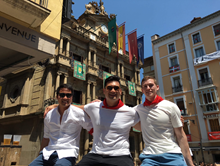



Hangi is our Gold standard around client leadership. The quality of his work, his attention to details, the long hours to go above and beyond allowed him to become a trusted advisor of various clients (VP Technology, VP Consumer Experience).

He always finds ways to obtain the information needed to support the work and is able to independently engage appropriate resources to support the work. Additionally, what keeps things interesting is that he comes up with creative ideas to address the problem and tries to push the envelope.
Hangi jumped into a tough pursuit in a difficult client environment involving multiple client groups (Board of Directors and PE investment group) that were not aligned about their expectations. Nonetheless, Hangi worked the situation extremely well, and developed a strong set of deliverables.

Hangi has been supporting on a major pursuit and executive workshop which has turned out to be a major opportunity. We presented this work to the top executives (c-suite & direct reports) and resulted in a green light to work on the Go-To-Market strategy.
AI Prototypes
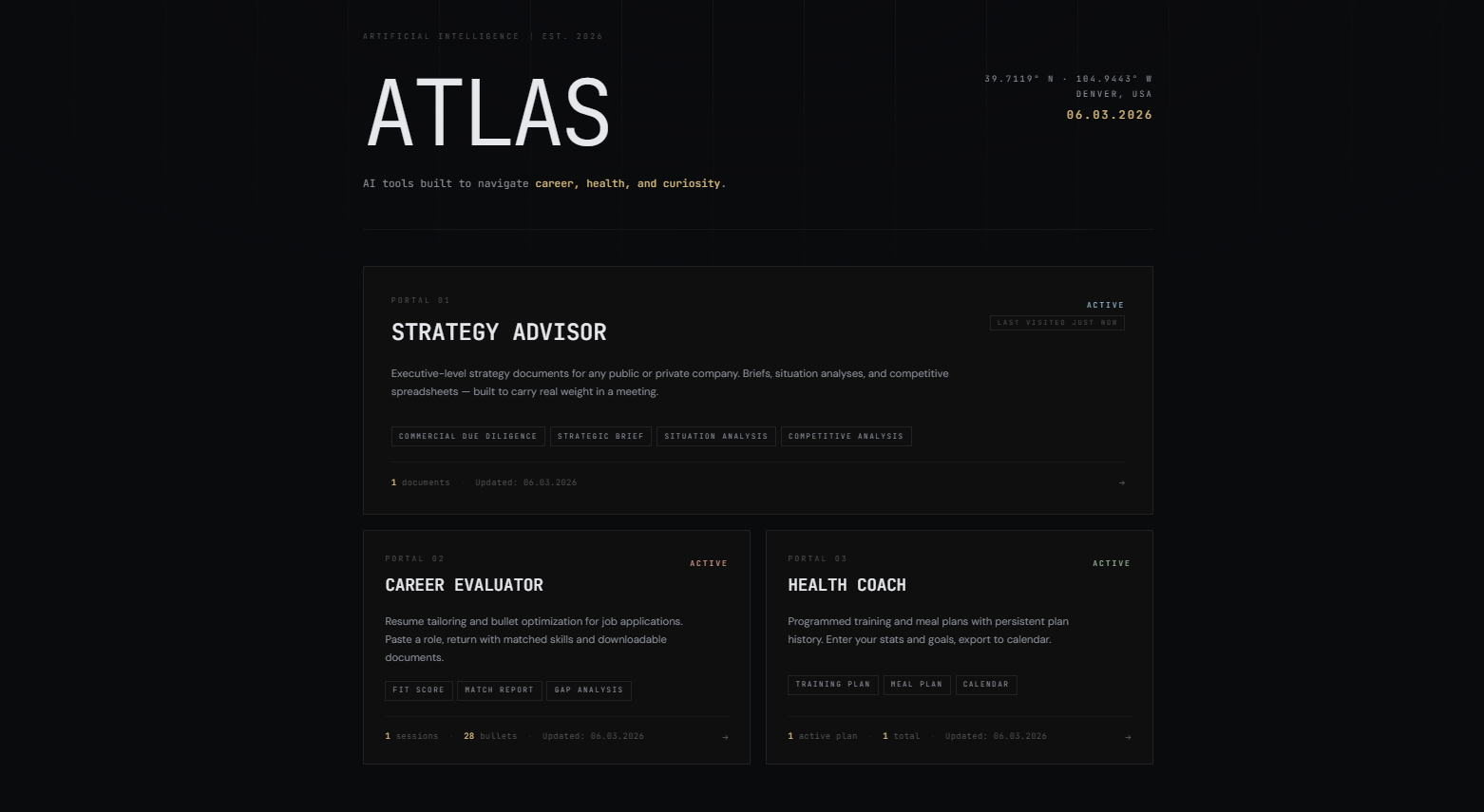
Atlas — a suite of three AI tools I built nights and weekends. Each one runs as a single HTML file, calls Claude's API, and ships without a build step.
"Armed with consulting experience, basic coding skills, and Claude as a partner — I feel like I can build and learn anything without fear of whatever that was stopping me before."
Portfolio Showcase
Architecture and Design
Atlas is the home base that ties the three tools together. They share one key, one design, and one simple idea: each tool is a single file you open in your browser and start using right away.
Nothing to install, no servers, nothing to set up — open it and it works.
The Suite
- Three real products, three real problems. One for work, one for health, one for life — each built because I actually needed it.
- A simple front end for Claude. The tool handles the back-and-forth with Claude behind the scenes, and plain code takes care of the repetitive parts — so you get the same kind of result every time.
- One shared look, all single files. Same design and same feel across every tool, nothing to install — open any of them in a browser and go.
Built with
Claude Cowork
Claude Code
Claude API
~1 month per tool · nights & weekends
Built · Live · Single File
What it does
An AI-powered career tool that tailors my resume to any job posting, scores my fit honestly, and tracks every application I send. Paste a job description — get back a Word doc tuned to that role, plus a fit score that tells me where my experience matches and where I'm stretching.
It used to take me about 45 minutes to tailor a resume by hand for every application; now it takes seconds. Application history saves automatically, and the tool pulls from a clean bank of my real experience instead of starting from scratch each time.
What I learned
- Ask AI for a strict format, not a chat. When I have Claude fill in a fixed template instead of "having a conversation," the answers come back clean and consistent every time.
- Clean your inputs first. Garbage in, garbage out — no clever wording fixes messy data. My experience list had grown from 25 sharp bullets to 57+ near-duplicates; trimming it back made the tool work better with fewer instructions.
- Don't assume the tool just "knows." My first version missed obvious matches — it didn't connect "build" with "built," skipped my skills section, and didn't realize "product management" can be written a dozen different ways. I had to spell the matching rules out.
Built · Live · Single File
What it does
Type a public company name. The tool produces three executive-grade documents — a 3-page strategic brief, a 5-page situation analysis, a 5-sheet competitive analysis spreadsheet — plus an interactive HTML dashboard with financial charts, SWOT grids, and citation tooltips.
Built for the moments when I need to walk into a room sounding like I spent a week on the company. Everything saves to a repository so I can revisit any analysis months later.
What I learned
- I bring the expertise; Claude does the building. The best results came when I described exactly what a strong analysis looks like and let Claude handle the how. When I was vague — "make it more strategic" — it just guessed, and it showed.
- Check it against reality, not against what looks right. Claude will happily produce numbers that look polished and are wrong. The only real test is reality: does this figure actually appear in the company's filing? Does the growth rate hold up when you redo the math?
- Make every claim traceable. Every number links to its source, every estimate shows a range, every date matches the data. If someone questions a figure, I can get back to where it came from in two clicks — if I can't, it's decoration, not analysis.
Built · Live · Single File
What it does
Enter your stats and goals. The tool builds a complete workout plan, a matched meal plan with macros, a grocery list, and an interactive dashboard for tracking progress over a 12-week program.
Started as a way to stop guessing my way through fitness — became my actual training plan, the one I'm eight weeks into right now. v2 replaced v1's static Word doc with a dashboard I open most days.
What I learned
- The only real test is whether I use it. I tried version one myself and just stopped — too complicated, spread across too many documents. Reviews and feature lists didn't matter; the person it was built for quit opening it. If you don't use your own tool the day after you make it, it doesn't work.
- Test it against your real life, not a checklist. Every version got tried against the plan I was actually running that week. "Can I read the workout on my phone at the gym?" was a real question with a real answer — the kind a checklist never catches.
- Less is more. Version one was a stack of documents that showed everything and felt overwhelming. "Too crowded" is a worse problem than "too empty" — boiling it down to four simple tabs on one page is what finally made it usable.
Process · Field Notes
Moments that humbled me
The first NVIDIA run through Strategy Advisor looked immaculate — polished charts, confident numbers. Then the check: the market-sizing funnel claimed a $200B total addressable market while showing NVIDIA's current revenue at $257B. The company's revenue exceeded the entire market it supposedly operated in. Logically impossible — and it sailed through visual review. The headline "172% CAGR" was actually ~100%. Looking right is not the same as being right.
Career Evaluator humbled me the same way: it confidently scored me a 92% fit for a job I had basically zero experience in. I'd only asked for a fit score and gap analysis — but my vague, guardrail-free prompt let Claude rewrite my resume to match the JD word for word. Nothing anchored it to my real experience.
That's why I write fidelity rules — guardrails that lock down WHAT is true and HOW the work was done, written BEFORE the creative instructions — and validate the model, not the prose. Without them, AI will happily reframe your reality into something more flattering than the truth.
Write your guardrails first. Let the creativity work inside them.
The process: plan → build → test → fix → repeat
01
Understand
What you're building and for whom.
What am I trying to solve? Every good feature starts with a real annoyance in your day. If you can't name the pain, you don't have a feature yet.
Is this for me, or for others too? Solo tools can stay scrappy. Anything you'll share needs polish and clearer inputs.
Recurring need or one-off? Recurring is worth building. One-off, just ask Claude directly and move on.
02
Plan the pieces
Map how the work flows from input to output.
What are the exact steps from input to output? Sketching it forces you to see the whole pipeline before any code exists.
Where does the data come from? User input? Uploaded file? Pulled from the web? Each source has different failure modes.
One prompt, or several? One prompt doing two jobs almost always produces mediocre results on both.
Deterministic or creative? Language is Claude's job; math is a formula's job. Claude can give different numbers to the same question.
Where will this live? A file on your desktop? A browser tab? Your calendar? If it sits in Downloads, it dies there.
03
Build
The simplest version, not perfection.
Is all the context in one project folder? Give Claude one place to find everything — it saves re-explaining context in every prompt.
Could a stranger follow my prompt? Vague prompts get vague answers. Be embarrassingly specific.
Feeding it Word docs or PDFs? Convert them to Markdown first. Claude reads Markdown reliably; it fakes reading PDFs more often than it admits.
What's the minimum version that actually works? Skip polish. Anyone can make a pretty dashboard — get to real output first.
04
Test, test, test
The step most people skip — and where you learn the most.
Does the first output match what I imagined? Probably not. Write down every gap — that's your fix list.
Do all the buttons actually work? Claude usually misses one or two. Click every single one.
Does it hold up across inputs? Try the obvious case, the hard case, and the weird case. Bugs live at the boundaries.
Are the sources real and cited? Tell Claude every claim needs a source and a reason. Then verify a few.
Does the math actually math? Double-check any percentage, total, or equation. Claude is confident even when it's wrong.
Am I asking too much in one shot? Break the ask into chunks. One section at a time.
05
Fix and repeat
This is most of the work.
Am I happy with the results? If not, another round.
Would I share this with a friend? That's the honest engagement bar.
Would I put it out publicly or sell it? That's the polish bar.
Rules I build by
Just start. The tools can paralyze you before you begin. Pick one, ask one question.
Write guardrails first. Lock down what's true before asking for anything creative.
Split the work. Two focused prompts beat one overloaded prompt, every time.
Clean inputs, always. Garbage in, garbage out. No prompt fixes messy data.
Match the delivery to the surface. Where the feature lives shapes whether you'll actually use it — verify it on every device, OS, and browser your audience will use.
Test. Test. Test. AI can review its own outputs, but only YOU can confirm it works and it's accurate. Don't get lazy — that's where AI slop comes from.
Every claim traceable. Two clicks back to the source — or it's decoration, not analysis.
"60-minute builds" are mostly a lie. Real features take real work. Sit with the AI long enough to know what it's actually building.